Defence ETFs: What Investors Should Know
June 2, 2026 |

This is a marketing communication.
For decades, Europe followed a simple formula: security was provided by the United States, while financial resources were allocated to other areas. That era now appears to be over. Since the outbreak of the Russia–Ukraine conflict, the security situation on the European continent has changed fundamentally – and with it the priorities of European governments. The figures clearly illustrate the scale of this shift: military spending in Europe increased by 17% in 2024 compared to the previous year, reaching a level higher than at the end of the Cold War. Of NATO’s 32 member states, 18 countries met the guideline of spending at least 2% of their respective economic output on defence for the first time – compared with only eleven countries a year earlier. Globally, defence budgets also rose to the highest level ever recorded.1
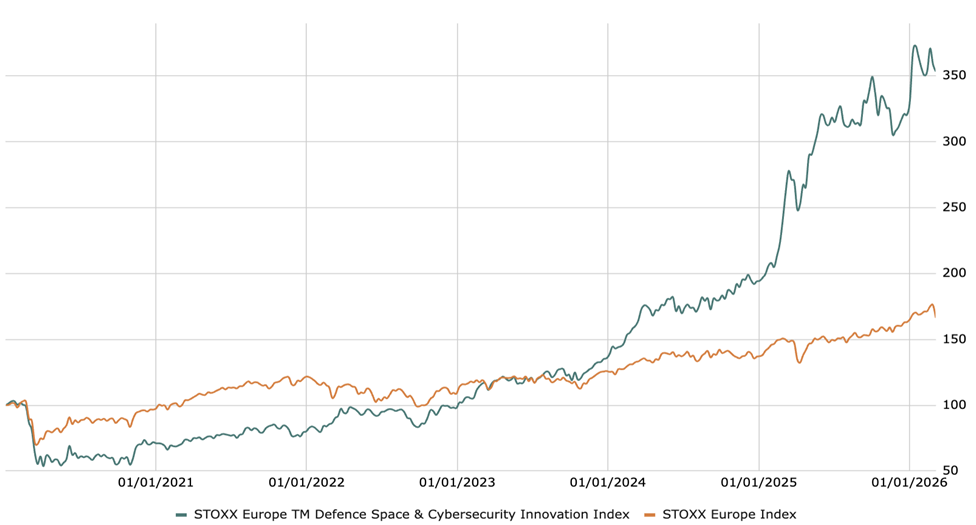
The STOXX Europe Total Market Defence, Space and Cybersecurity Innovation Index is a rules-based equity index by STOXX Ltd. that reflects the performance of selected European companies in the defence, aerospace and cybersecurity sectors. The STOXX Europe 600 Index is a rules-based equity index by STOXX Ltd. that reflects the performance of 600 large, mid-sized and small publicly listed companies from 17 European countries. The chart shows performance in euros (indexed; 100). Period: 03/01/2020 to 06/03/2026. Source: Bloomberg, own illustration by DWS Investment GmbH, 2026. Past performance is not a reliable indicator of future performance.
Financial markets have also recently reflected these developments. Compared with the broader European market, the defence sector – including aerospace, satellite technology and cybersecurity – has generated a noticeable outperformance (see chart). Unsurprisingly, inflows into defence ETFs have also increased over time.2 But what exactly lies behind these products, what are the opportunities and risks, and what should investors pay attention to? One step at a time.
Defence ETFs are exchange-traded index funds that invest specifically in companies from the defence and security industry. Their scope often goes beyond traditional defence products such as fighter jets, tanks or missile defence systems. Depending on the index, companies from aerospace, satellite technology or cybersecurity may also be included.
A particular feature of the sector is its customer structure. Buyers are predominantly government institutions with long-term, relatively predictable budgets.3 This represents a significant difference from many other industries, where demand can be more strongly influenced by economic cycles. Instead, the sector’s development depends primarily on the geopolitical environment: rising tensions and conflicts tend to lead to higher defence budgets.
Compared with broad market indices, Defence ETFs typically include fewer companies. Many of these products comprise only a few dozen constituents, with a handful of the largest positions accounting for more than 50% of fund assets. This concentration can, in turn, lead to higher price volatility than in more broadly diversified ETFs.
At the same time, a variety of approaches exist today to gain exposure to the theme. A somewhat broader interpretation of the sector – for example, by incorporating satellite technology and cybersecurity – can help mitigate a concentration risk in a small number of companies. Another characteristic of the defence industry is its high level of investment in research and development. Many technologies originally developed for military purposes later find civilian applications, for example, in commercial aerospace. In addition, it is not only the major defence contractors themselves that benefit from rising defence budgets. Suppliers can also play an important role, from speciality steels and composite materials to sensors, with specialised companies involved throughout the entire value chain.
Some ETFs pursue an expanded thematic approach with a specific emphasis on Europe. The Xtrackers Europe Defence Technologies UCITS ETF, for example, tracks the index shown in the chart. It reflects the performance of a basket of European companies involved with activities in the defence, aerospace and cybersecurity sectors. Stock selection is based, among other factors, on patent data to identify companies with a particularly high level of innovation.
Overall, Defence ETFs can provide access to a sector currently experiencing strong momentum in government spending. At the same time, they exhibit specific characteristics, such as a comparatively high concentration in a single sector and the resulting higher volatility. Taking a close look at the index composition can help identify a suitable product. As with all ETF investments, Defence ETFs are subject to market fluctuations and may incur losses.
1 SIPRI, 2025, Trends in World Military Expenditure, 2024, SIPRI Fact Sheet, accessed on 12/03/2026: https://www.sipri.org/sites/default/files/2025-04/2504_fs_milex_2024.pdf
2 DasInvestment, 2026, Diese Rüstungs-ETFs sammelten 2025 das meiste Geld ein, accessed on 13/03/2026: https://www.dasinvestment.com/top-10-etfs-2025-ruestung-verteidigung-zufluesse/
3 Easyfolio, 2024, Rüstungs-ETF: Lohnt sich das Investment in Verteidigung?, accessed on 12/03/2026: https://easyfolio.de/aktuelles/details/ruestungs-etf#:~:text=Stabile%20Ertr%C3%A4ge:,zu%20stabilen%20Ertr%C3%A4gen%20f%C3%BChren%20kann
The fund is not capital protected. The value of your investment may both rise and fall. Past performance is not a reliable indicator of future performance. The following applies if you subscribe to or redeem fund units in a currency other than the currency of the fund or unit class: please note the currency risk. You will receive payments in a different currency, meaning that your final return will depend on the exchange rate between the two currencies. The fund is subject to currency risk. Foreign exchange markets can be highly volatile. Significant exchange rate fluctuations can occur within very short periods and may result in a loss in relation to your investment.
The fund is exposed to movements in equity markets in a single country or region, which may be adversely affected by political or economic developments, government measures or natural events – risks that a broadly diversified fund might not face. The value of an equity investment depends on a number of factors, including market conditions, the current economic environment, the industry, the geographic region and political events. The fund focuses on a single or a limited number of economic sectors, industries or types of companies, and its performance may not reflect the gains of broader markets.
All opinions expressed reflect the current assessment, which may change without prior notice. Forecasts are based on assumptions, estimates, views and hypothetical models or analyses that may prove to be incorrect or inaccurate. Past performance is not a reliable indicator of future performance.
Source: DWS International GmbH; as at 22/04/2025.
Risk Disclaimer – There are risks associated with investing. The value of your investment may fall or rise. Losses of the capital invested may occur. Past performance, simulations or forecasts are not a reliable indicator of future performance. We do not provide investment, legal and/or tax advice. Should this website contain information on the capital market, financial instruments and/or other topics relevant to investment, this information is intended solely as a general explanation of the investment services provided by companies in our group. Please also read our risk information and terms of use.