
Bits & Pieces
Edition #300 | 09/10/2026
Most traded | Markets & Macro | Gaming | Chart of the Week | Value-ETFs | Scalable News | Retirement in Focus
Today, the 300th edition of the “Bits & Pieces” newsletter is hitting in your inbox. Since the first edition nearly six years ago, the market has fundamentally changed. Back then: zero interest rates powering a Covid-era economy, and Bitcoin nearing the $20,000 mark for the first time. Today: stubborn inflation, bond yields topping 5%, Bitcoin past $80,000, and an economy obsessed with AI.
What a ride! But between the 1st and the 300th edition, there is a subtle commonality: the biotech company Moderna managed to be mentioned in both editions. Back then, it was among the “most traded” stocks. This time, the company is hiding somewhere between high yields, funflation, and stock market hypes. We hope you enjoy the search!
This newsletter contains ads.
Note: The data refers to the ratio of purchases and sales of the 100 most traded stocks in the Scalable broker between 02/10/2026 and 08/10/2026.
In the spotlight: Accenture
Following the release of its latest figures, Accenture's stock was up significantly—whereupon many cashed in their profits. The consulting giant reported record bookings for the last quarter, driven by the AI boom. After all, Accenture advises major corporations on how to integrate AI into their business processes.
Treasury fever
On Wednesday, yields on 10-year US Treasury bonds briefly climbed to 5.35%—the highest level since 2002. The problem: high yields raise borrowing costs for governments and companies and draw capital away from the stock market. But governments have ways to influence yields.
The auction effect: The US Treasury used high interest rates as a lure for an auction of ten-year US Treasuries. The high yield triggered a surge in demand: as many wanted to buy the bonds, prices climbed—causing effective yields to fall subsequently (higher prices = lower yield).
Double catalyst for the dollar (18-month high): Global investors exchanged foreign currencies for dollars to snap up the US bonds. The demand pushed the currency further up. And the Fed is supporting the greenback too: the latest US Federal Reserve meeting minutes (FOMC Minutes) make it clear that interest rates will remain “higher for longer”.
Conclusion for your portfolio: US assets such as stocks or ETFs without currency hedging gain value in euros purely due to the stronger dollar. At the same time, the euro is under pressure, making energy and commodity imports more expensive for Europe—keyword imported inflation—and restricting the ECB's room to maneuver.
The inflation antidote: Gaming?
Traveling is always expensive, but currently, it hurts the wallet even more due to inflation. Many are turning to simpler pleasures: according to data from Bank of America, spending on hobbies in the US rose by 7.9% year-on-year in August. A niche industry is benefiting from this so-called “funflation”: gaming. According to the study, all age groups spent more money on video games. For Gen Z (aged 14–29), it was 20% more, and for older Baby Boomers (aged 62–80), even 30% more than in the previous year.
A video game costs an average of around €70 and delivers hours or even weeks of entertainment in return. The best example: the main story alone of the highly anticipated blockbuster title Grand Theft Auto VI from Rockstar Games (Take-Two Interactive), releasing on November 19, is set to deliver up to 80 hours of gameplay—, meaning it costs less than one euro per hour of play.
In addition, there are offers like the Xbox Game Pass from Microsoft or the PlayStation Plus subscription from Sony. For a modest monthly fee, you get access to huge game libraries. This business model allows tech giants to turn the traditionally cyclical gaming business into predictable and recurring revenue. On the stock market, investors have a choice: pure-plays like Take-Two depend directly on the success of individual game stocks, while tech giants like Microsoft and Sony use gaming as a stable subscription pillar within the overall group.
Mountains, schnitzel, and a killer stock performance
ATX vs. S&P 500 EUR. Five-year performance (indexed at 100)
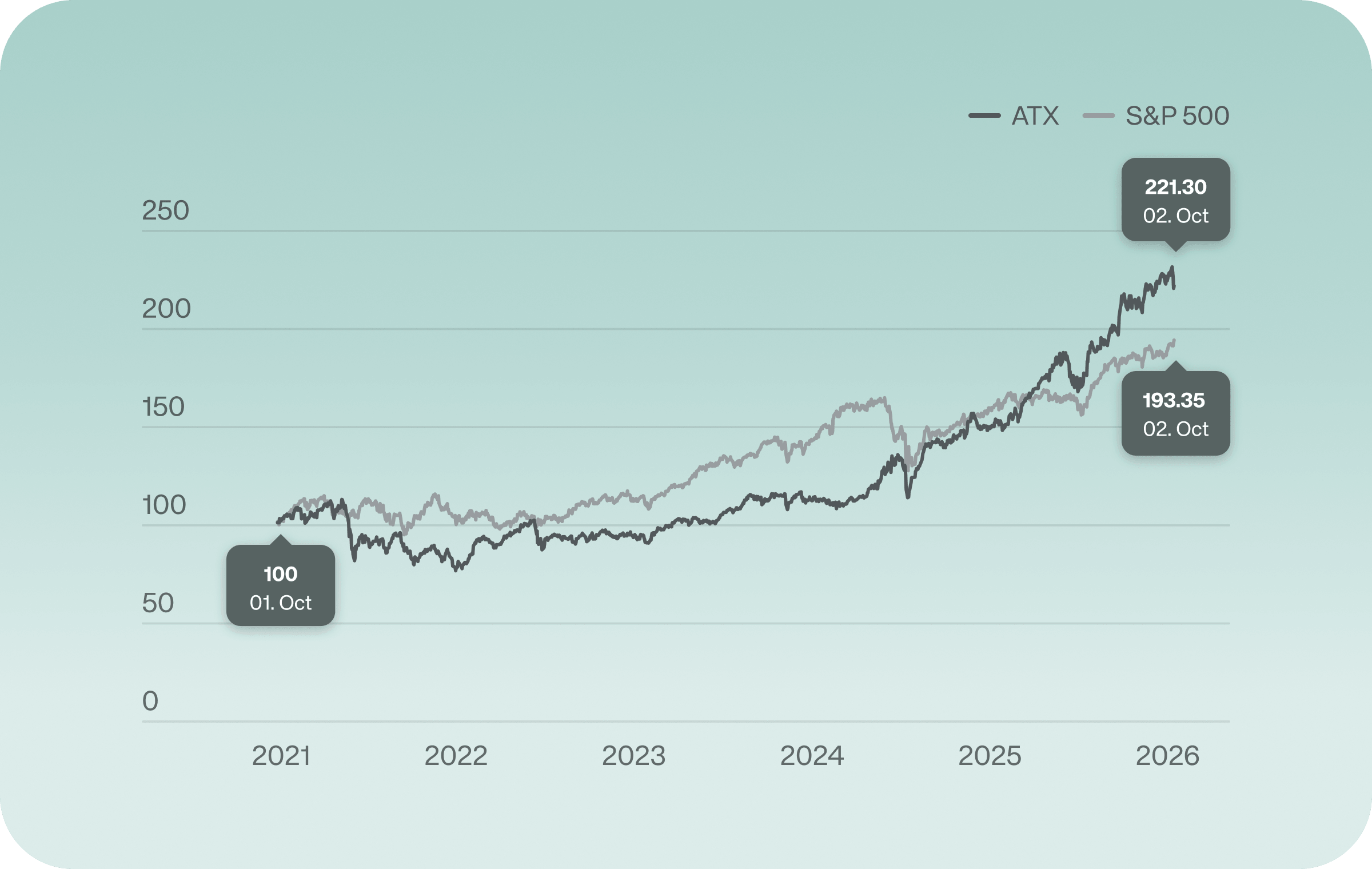
Source: Xtrackers ATX UCITS ETF, iShares Core S&P 500 UCITS ETF (on euro basis), Scalable Chief Economist Christian W. Röhl
Who would have thought: the US stock market is often considered unbeatable, but over a five-year period, the Austrian benchmark index ATX has significantly outpaced the mighty S&P 500. The Vienna stock barometer climbed by around 120% in a five-year comparison, while the US benchmark index (in € terms) gained just over 90%.
How did Austria achieve this? Entirely without tech giants—which, by contrast, drive rival S&P 500. In the Alpine country, financials dominate, such as BAWAG; altogether, the financial sector accounts for a weight of over 45% in the ATX. This industry was able to reap high profits thanks to rising interest rates. Alongside them are value greats like the steel company voestalpine or the energy group OMV, which give the ATX a return advantage over the S&P 500 with solid balance sheets and high dividend yields.
Good to know: The ATX tracks the performance of the 20 largest listed Austrian companies, whereas for the S&P 500, it's 500 US players. This means that individual stocks carry greater weight in the ATX and can move the entire index.
Furthermore: Scalable is now represented on site in Austria with its own bank branch. More info below in Scalable news.
Riding the hype is easy
How dependent is your portfolio on US Big Tech? Be honest. There's fundamentally nothing wrong with growth stocks as an engine in your portfolio. But: they might be expensive. So why not shop for some stock market bargains—and for diversification?
Substance over hope. Especially in times of rising interest rates, value stocks move back into the spotlight. Insurers, pharma groups, utilities, or consumer staples manufacturers have stable cash flows and strong pricing power. Yet substance doesn't automatically mean size. Small caps can be worthwhile—they are frequently market leaders in their segment and attractively valued far away from the media hype.
Classically defensive. With business models that are indispensable to daily life, telecommunications and utilities are among the quintessential value sectors. Internet, mobile communications, electricity, and water are always needed. Predictable revenue makes them reliable dividend payers. Opportunities also lie in a possible easing of EU merger controls, while at the same time regulation and high debt burdens pose a risk.
Treat from Vienna
Effective immediately, Scalable now operates a local branch in Austria. As a result, local clients now enjoy key perks:
- New clients receive an Austrian IBAN directly upon opening an account.
- If you live in Austria and are already a client, you will soon receive information via email regarding moving your account.
- Scalable automatically calculates, withholds and remits the capital gains tax (KESt).
Fixed-term deposit now also for 6 months
With Scalable fixed-term deposit, you secure 2.75% interest p.a.*starting from just €1 with no upper limit.
In this section, you can find everything you need to know about planned retirement savings account (AVD).
Today, we announce further details regarding the self-directed retirement savings account:
- You manage your investment yourself and can flexibly invest for your future with stock, bond, and commodity ETFs, private markets (ELTIFs), and funds.
- When saving for retirement with the Scalable World ETF and many ETFs from BlackRock, DWS, and Vanguard, product costs (TER) are completely eliminated: through the Scalable pension bonus, the TER is credited back and reinvested.
- You can get started immediately, as the pension bonus is already available for purchases and savings plans until the end of the year in the broker, paid into the retirement savings account.
- Starting in January, you will then receive government subsidies of up to € 540 plus € 300 per child per year, as well as additional tax benefits in the retirement savings account.
Editorial deadline: Friday, 7 a.m.
Sources: Scalable and dpa-AFX