
Bits & Pieces
Edition #299 | 02/10/2026
Most Traded | Markets & Macro | Garmin | Chart of the Week | Corporate bond ETFs | Scalable News | Retirement in Focus
Micron's recent quarterly figures show that the AI train runs full steam ahead for now. Meanwhile, wearable specialist Oura is stepping on the brakes, but the industry offers another high flyer. Also: How can you benefit from the current interest rate environment? Spoiler: corporate bonds. In addition, the most wonderful time of the year is starting on the stock market—if historical data is any good.
This newsletter contains ads.
Note: The data refers to the ratio of purchases and sales of the 100 most traded stocks on Scalable Broker between 25/09/2026 and 01/10/2026.
In the spotlight: Bloom Energy
The fact that Bloom Energy's revenue cracked the one billion dollar mark for the first time last quarter provided a proper boost for the stock—followed by profit-taking. At the same time, market skepticism is growing over the energy technology company's dependence on power-hungry AI data centers.
When tech carries the market—and keeps interest rates high
Normally, rising interest rates should weigh on stocks. But there is little sign of that at present: The S&P 500 has risen significantly since the beginning of the year.
However, a look beneath the surface shows that tech in particular is carrying the market. The Information Technology sector has gained nearly a third since the start of the year. NVIDIA, Apple, AMD, and Micron are among the major drivers. In contrast, the equal-weighted S&P 500, which is not driven by the IT sector, has gained significantly less.
The AI boom might not only be affecting stock prices. According to Morningstar, massive investments in data centers, chips, and AI infrastructure could contribute to interest rates staying higher for longer. The reason: to prevent the economy from overheating due to this massive demand shock, the US Federal Reserve is keeping interest rates high. This dampens inflation, but shifts the pressure entirely onto cost of capital.
The punchline: Tech heats up interest rates, but has the deepest pockets itself, leaving the remaining sectors to suffer.
No "ring on it" after all
The market for wearables such as the Apple Watch or the Xiaomi Smart Band is highly competitive. They can do much of what the modern, health-conscious person desires today: They track fitness, monitor sleep, check health data, and some even replace reaching for your wallet at the checkout. Nevertheless, smart ring pioneer Oura postponed its IPO on Tuesday, citing general market uncertainty. This draws attention to a specialist that has long proven its quality on the stock market: Garmin.
While giants like Apple and Samsung dominate the market through sheer volume, Garmin proves that a niche strategy can also bear fruit. The Swiss company has deliberately set itself apart from the pure lifestyle segment. Garmin targets professionals in competitive sports and outdoor activities, as well as specialists in marine and aviation. The clientele is willing to pay premium prices for this reliable equipment—which brought the company record revenue of over $ 2 billion in the last quarter. The gross margin was 62.4 %, an increase of 3.6 percentage points compared to the previous year. This was possible, among other things, because Garmin relies on in-house manufacturing unlike many rivals, meaning no costs are incurred for external contract manufacturers.
Another success factor: the Garmin Connect app. It sets the standard for analyzing training data. The lock-in effect is strong: Anyone who has collected running, cycling, and performance data in this ecosystem for years won't switch brands easily.
The best comes at the end
Probability of a positive net return on the MSCI ACWI, accumulated since 1970
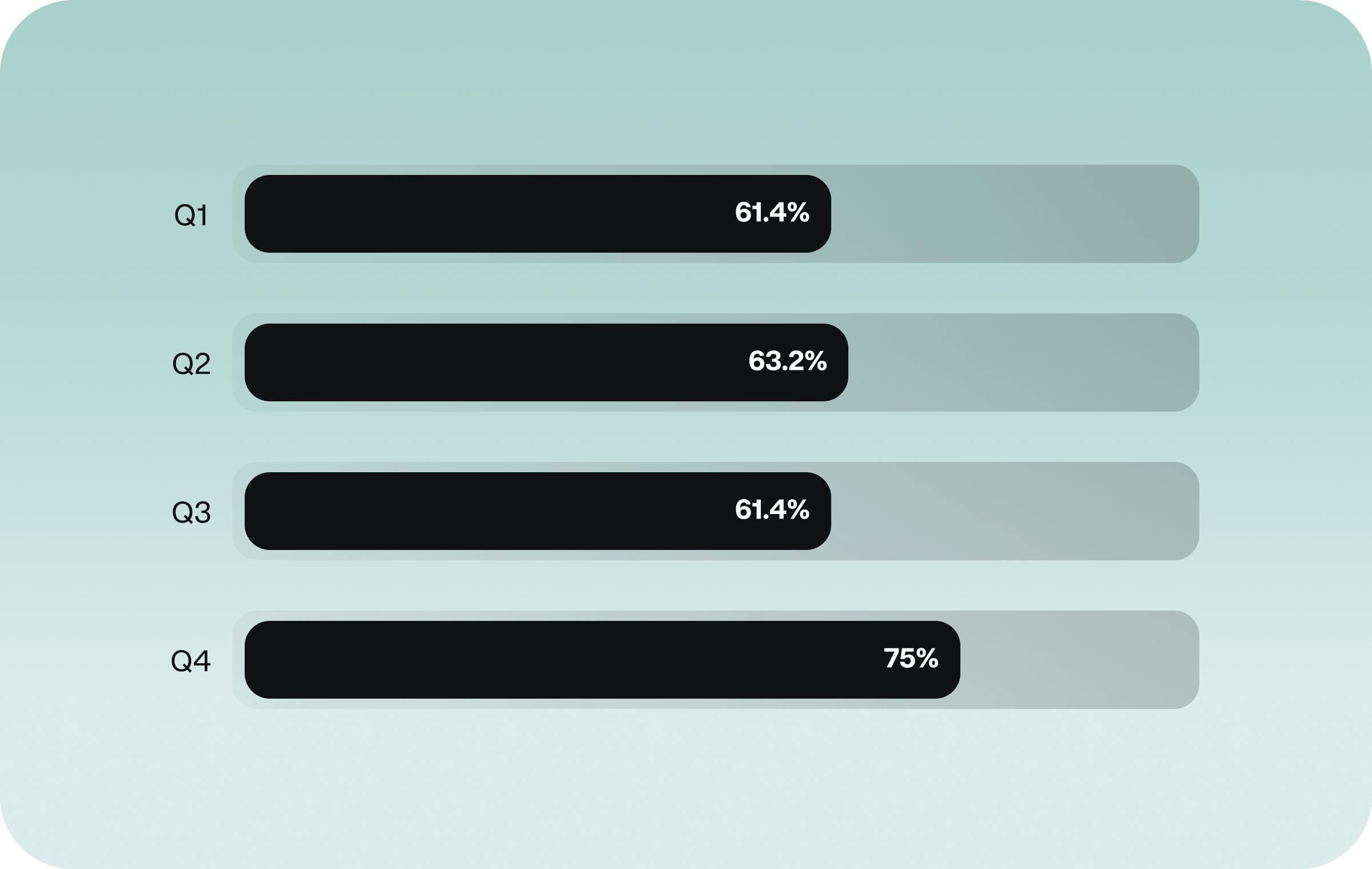
Sources: MSCI, until 31.12.2000: MSCI World Index; until 31.12.1998: Deutsche Mark. Scalable Capital Chief Economist Christian W. Röhl
Autumn is around the corner. While this dampens the mood for many at first, it is a reason for joy for investors. Historically speaking, the fourth quarter is peak season on the stock market.
A look at the performance of the MSCI All Country World Index (ACWI) since 1970 shows: In 42 out of 56 years, a positive net return was achieved in the final quarter—a success rate of 75%. And the probability of a year-end rally even rises to 80% if the previous three quarters had already achieved a gain of at least 10%. By the way, this condition has already been met for this year.
Midterm elections in the US could provide an additional boost this year. At least in the long term. Historically, investors were cautious around the midterms in November. But after the election, the stock market usually picked up and delivered strong results for the last quarter of the year.
Interest rate thrill
Stock markets generally show little euphoria in response to rising interest rates. But for you, this also means: You can get higher interest rates on government and corporate bonds. The general rule is: the longer the maturity, the higher the risk. Anyone who understands these interest rate basics can use rate changes in a targeted way for their portfolio.
With rising interest rates, existing bonds with lower interest become unattractive. The consequence: Investors sell. As a result, the bond price falls, while at the same time the yield rises because the same paper now costs less. Through bonds, not only governments but also companies obtain fresh capital. For example, Danone recently issued a new Euro bond. Investors benefit from a risk premium (credit spread) on corporate bonds, as the default risk is greater here than with governments.
With corporate bond ETFs, you spread the risk and diversify your stock portfolio on top of that. Which ETF is right for you depends on your expectations on interest rates. With a floating rate, you protect yourself against capital losses from duration; for risk-averse investors, ETFs with short maturities are ideal. The entire spectrum of Euro corporate bonds with an average maturity of eight years brings greater leverage—but this also comes with greater risk.
Extended trading hours
The early bird catches the worm. That's why you can now start trading even earlier at Scalable. Effective immediately, the European Investor Exchange opens 90 minutes earlier, allowing you to be active between 6:00 am and 11:00 pm. This allows you to benefit from the earliest market start in Europe and, at 17 hours, the longest opening time of any major trading venue worldwide.
In this section, we provide quick, direct answers to your key questions about the proposed retirement savings account for Germany.
I have a Riester contract and am thinking about switching to the AVD. What is one of the core differences between the models that I should consider in my decision?
- With Riester, the focus is on security. Thanks to a contribution guarantee, at least your paid-in contributions plus subsidies must generally be present at retirement. The disadvantage: Your money is therefore in conservative assets, which reduces your return.
- The AVD prioritizes returns. You access the capital market through investments in ETFs, funds, or private markets, which can yield higher returns in the long run thanks to the compound interest effect. In doing so, you must factor in potential short-term market fluctuations.
- Easy switch possible. For the planned launch in January 2027, you can initiate a transfer online at Scalable or via your current provider. You only need to tell us three details from your old contract, such as your contract number.
Editorial deadline: Friday, 7 a.m.
Sources: Scalable and dpa-AFX