
Investors on edge? Admittedly, the past few weeks have been a bumpy ride, so we’d rather focus on the crisis-proof performers holding their ground in choppy waters. Meanwhile, there’s no sign of a downturn on Black Friday – with both bargain hunters and a host of retailers having plenty to celebrate. Plus: an Italian upcycler that has turned breathing new life into old brands into a fine art.
This newsletter contains ads.
What’s on our mind
An anniversary stress test
He’s back: eleven days after stepping down, Jensen Huang has returned as CEO of NVIDIA. Wall Street initially cheered the coup with the stock’s biggest jump in nearly five years, though the euphoria soon fizzled out. After all, if the multi-trillion-dollar AI ecosystem is so reliant on a single individual that even the White House pushed for Huang’s reinstatement, the boom suddenly looks rather fragile – quite apart from NVIDIA’s opaque dealings in Asia.
Make no mistake: four years after ChatGPT’s public launch in late November 2022, the AI narrative is facing its first serious reality check. For overall market hygiene, that’s no bad thing – though for tech investors, it’s proving a gruelling stress test. Since June’s hype-fuelled peak, chip stocks have shed around 40% (as measured by the Philadelphia Semiconductor Index), handing back most of this year’s gains. Broad-market indices, by contrast, are holding up remarkably well: in euro terms, MSCI AC World ETFs are less than 6% underwater. With the much-discussed "chip concentration" in global portfolios having shrunk by over a quarter, one lesson stands out once again: diversification works.
Bending Spoons
Milan’s brand turnaround specialists
Last week, Bending Spoons sealed its biggest deal to date, snapping up the struggling newsletter platform Mailchimp from US software giant Intuit for $3.68bn. It’s the ideal target for Bending Spoons, which operates much like a private equity fund for internet brands: it buys up stagnating web businesses, streamlines them ruthlessly for efficiency, and monetises them via subscriptions.
The playbook is paying off. Built on this model, Bending Spoons made a stellar Nasdaq debut on 1 July – with Berkshire Hathaway on board from day one. Its portfolio now spans more than 50 acquisitions, including Evernote, WeTransfer, Vimeo, Eventbrite, Komoot and AOL.
Still, it’s debt-fuelled growth. Q3 revenue surged 125% to $780m, with full-year 2026 sales projected to reach up to $3.09bn. At the same time, its relentless acquisition spree has pushed net debt to roughly $4bn – more than double its operating earnings. Future growth hinges on finding enough attractive takeover targets, all while traditional private equity firms are hot on its heels.
Chart of the Week
Shoppers keep spending
How much shoppers in Germany spend on Black Friday & Cyber Monday (in €bn)
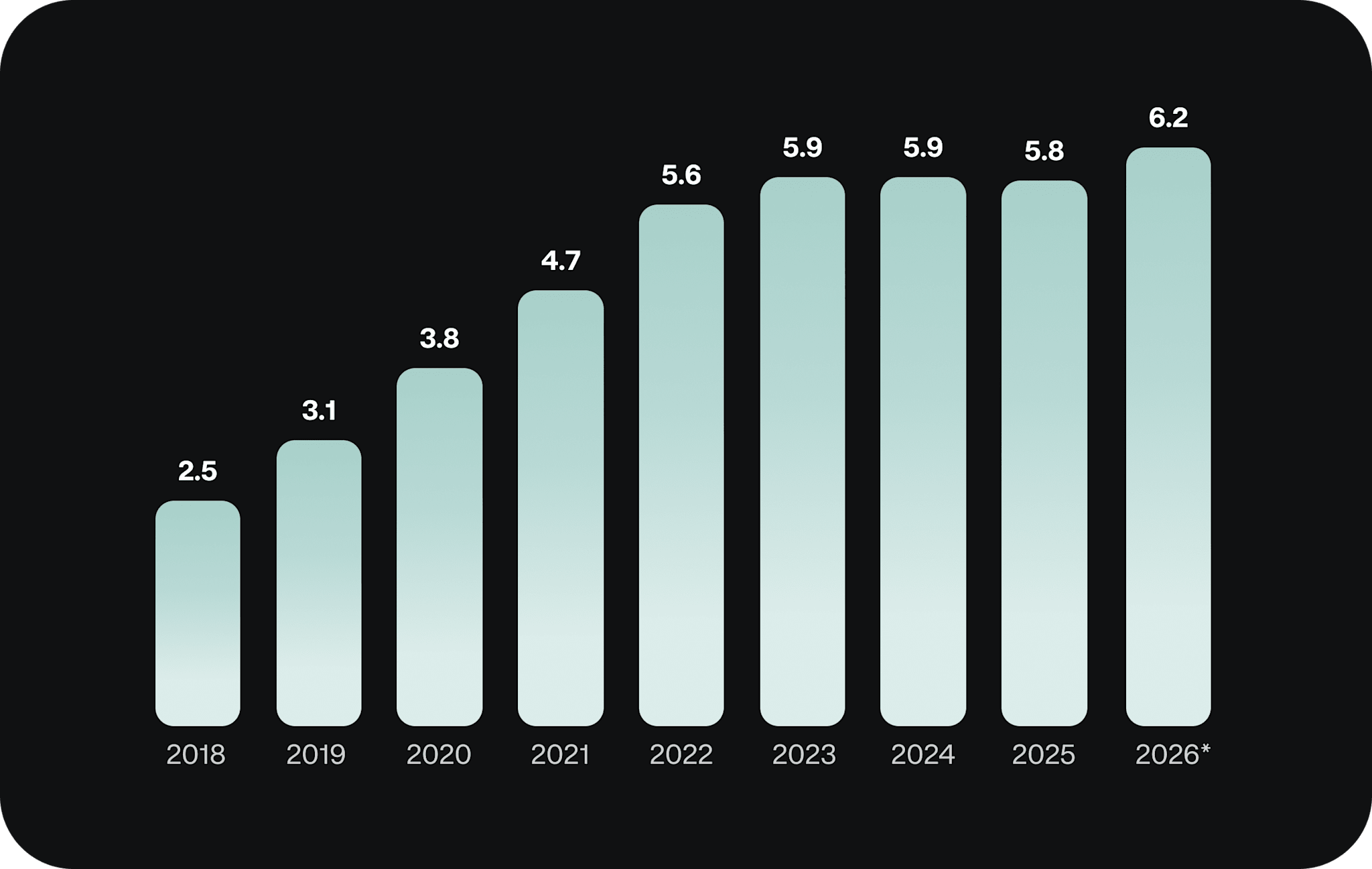
Source: HDE, *estimate
Even with investors rattled and Wall Street’s "fear gauge" – the VIX – sitting at its highest level of the year, one corner of the market far removed from AI and tech is hitting peak season: retail. The biggest shopping weekend of the year is here, kicking off with Black Friday today and wrapping up with Cyber Monday.
While US investors have been piling into defensive supermarket heavyweights like Walmart and Costco – both up double digits since October as safe havens – the DAX spotlight is on classic consumer and logistics names directly benefiting from the parcel and order boom. For Zalando and Adidas, the stretch from Black Friday through to Christmas is the single most important window for shifting fashion and sportswear.
According to forecasts from the German Retail Federation (HDE), shoppers in Germany are set to spend even more than last year – proving that despite sluggish economic growth and choppy markets, consumers are still willing to loosen the purse strings when a bargain is on offer.
Most Traded
Bought:
Sold:
Note: The data refers to the ratio of purchases and sales of the 100 most traded stocks on Scalable Broker between 20/11/2026 and 26/11/2026.
In the spotlight: Sanofi
Shares in pharmaceutical giant Sanofi recently posted their biggest single-day gain since 2008 after the French drugmaker announced a $41bn takeover of US biopharma firm Insmed. The deal secures a vital new growth engine ahead of the early-2030s patent expiry on Sanofi’s blockbuster drug Dupixent. Profit-taking followed shortly after.
ETFs
Beyond the tech drama
Investors have needed nerves of steel over the past few weeks. Yet rather than burying our heads in the sand over tech, we’re looking at the companies that have largely shrugged off the recent turbulence: defensive stocks.
These are the makers and providers of everyday essentials – toothpaste, cleaning products, plasters, electricity and water – whose earnings are comparatively predictable. That’s why utilities, consumer staples and healthcare giants tend to hold steady even when markets turn stormy. With defensive ETFs, you can add a whole basket of these crisis-resilient stalwarts to your portfolio, many of which boast decades-long track records of reliable dividends.
The one catch? Because these cash cows are in high demand amid volatile markets, their valuations are looking fairly pricey relative to their growth.
Scalable News
One login, additional broker accounts
You can now add multiple broker accounts under a single Scalable login. You can open up to two additional accounts, and setting one up in the app takes just a few seconds: Home > Add new product > Broker – and you’re good to go. It’s an easy way to name, organise and track different investment strategies separately.
Twelve months of PRIME+ on us
We’re currently giving all new clients twelve months of PRIME+ for free – including flat-rate trading, full access to Insights for in-depth portfolio analytics, and unlimited portfolio groups to keep everything neatly organised. Simply sign up and open an account by 30 November 2026. Terms and conditions apply.
Retirement in Focus
How much does the state actually chip in for the new German AVD? Many people significantly underestimate the government subsidies on offer – according to a survey of 500 respondents commissioned by Scalable and conducted by Appinio.
How much do you think the maximum annual state subsidy is for the new Altersvorsorgedepot (AVD)?
Here’s what respondents guessed:
Up to €250: 29.2%
€251 to €400: 19.8%
Not sure: 22.4%
In reality, the maximum basic annual state allowance for adults is €540, provided you contribute €1,800 a year yourself. On top of that, there’s up to €300 extra per child each year, plus a one-off €200 bonus for under-25s. That means nearly half of those surveyed (49%) underestimated the subsidy by a wide margin. You can already pre-register for the AVD with Scalable and work out your potential subsidy using our AVD Calculator.
Editorial deadline: Friday, 7 am
Sources: Scalable and dpa-AFX

Bits & Pieces is the heart of our editorial team, and the versatility of our writers shapes every single issue of the newsletter.
Team Lead Sophie is an economist and trained journalist who spent several years analyzing market developments live from New York as a Wall Street correspondent for outlets including ntv and Media Pioneer. As a trained business journalist and architect, Verena pursues her passion for macroeconomics and has previously reported for Bloomberg and Focus Money.
Above all, they both live and breathe their own passion for stocks, ETFs, and investing.
Mehr lesen?
Jetzt unseren Newsletter abonnieren und Börsen-News jeden Freitag direkt ins Postfach erhalten.
Es gelten unsere Datenschutzbestimmungen. Die Zustimmung kann jederzeit widerrufen werden.