
Feeling the chill? We’ve got you covered. Turns out, you can shop for winter coats on the stock market, too-think Moncler, Bosideng, or Canada Goose. And if you’re looking for something to warm your heart, take a trip down memory lane with our throwback on Deutsche Telekom, now celebrating 30 years as a public company.
Meanwhile, things are heating up at NVIDIA, where interim CEO Colette Kress just delivered a blowout quarter following Jensen Huang’s turbulent departure. While the AI boom continues to dominate the markets, gold-the supposed safe haven-is noticeably losing its luster. What is a sure thing, however, is a hassle-free, fee-free transfer of your Riester contract to the Scalable Retirement Account.
This newsletter contains ads.
What’s on our mind
NVIDIA’s new reality
All eyes on NVIDIA: Interim CEO Colette Kress, the company's longtime CFO and an NVIDIA veteran, delivered strong numbers. Fueled by continued momentum in its core data center business, NVIDIA more than doubled its revenue from $57 billion a year earlier. For the current quarter, Kress guided for another 90% surge to roughly $130 billion, beating analyst expectations.
Still, Jensen Huang’s departure casts a long shadow over the results. Talk about irony: Just a year ago, Huang dismissed the "China hawk" label as a "badge of shame" and "unpatriotic." Now, his affair with an alleged Chinese spy is giving fresh momentum to lawmakers pushing to regulate AI and put tighter guardrails on U.S. business dealings with China.
Adding to the geopolitical backdrop, U.S. President Donald Trump sat down with Xi Jinping and Vladimir Putin on the sidelines of the APEC summit in Shenzhen, China, yesterday of all days. No concrete policies came out of the meeting. The trilateral summit largely sidestepped major flashpoints like Ukraine, Iran, and Taiwan-serving mostly as a stage for a symbolic show of unity so each leader could claim a win back home.
VIP Watch
Colette Kress cleans house
Following founder Jensen Huang’s abrupt resignation amid major scandals, NVIDIA CFO Colette Kress has taken the helm as interim CEO. She’s stepping into the role at a critical juncture-just days into the job, she was already running the Q3 earnings call. Her motto: business as usual. Still, few can picture NVIDIA without Huang; Donald Trump and Elon Musk are already calling for his return.
That said, while Huang turned the company into a juggernaut, Kress-known for her fiscal conservatism-could curb NVIDIA’s more aggressive impulses. She previously single-handedly cut a planned $250 billion guarantee for OpenAI in half. Under Huang, more than $100 billion flowed into AI startups and cloud providers, which then turned around and spent that money on NVIDIA chips. Analysts expect Kress to rein in that practice.
As interim chief, Kress plans to put guarantees for so-called "neoclouds" under tighter scrutiny and return more excess cash flow to shareholders.
Kress’s promotion is a textbook example of the "glass cliff"-the phenomenon where women are disproportionately tapped for top leadership roles during times of crisis. Case in point: Linda Yaccarino at X, Mary Barra at GM, and Marissa Mayer at Yahoo.
Chart of the Week
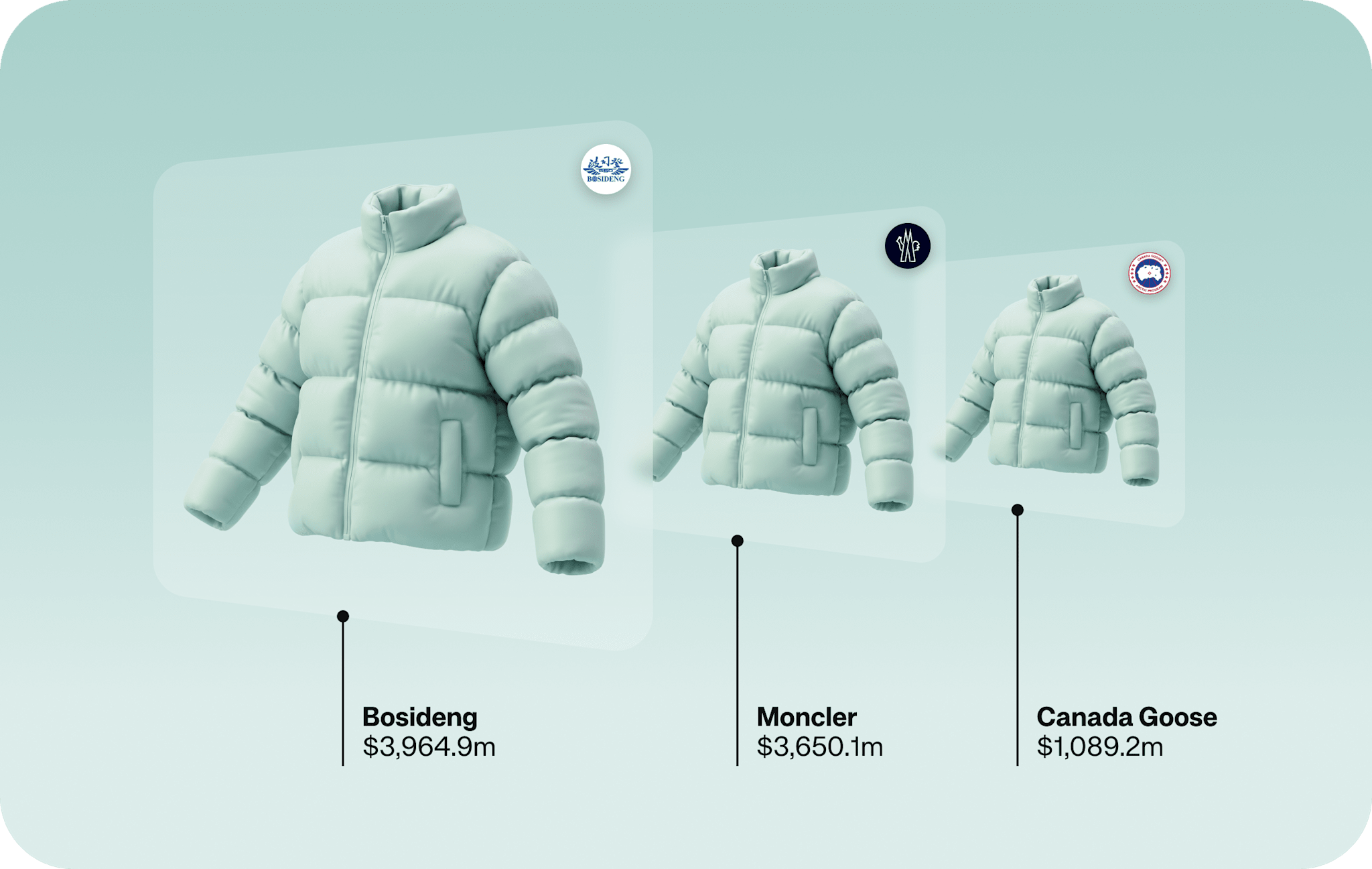
Warm coats, chilly stocks
Latest reported 12-month revenue by brand ($M)
Source: Fiscal AI
Glossy nylon on the outside, premium goose down on the inside, and the stylized twin peaks of Mont Aiguille paired with the Gallic rooster emblazoned on the chest: For decades, Moncler’s winter coats have been the ultimate cold-weather status symbol-and a lucrative business for the brand, which was founded in Grenoble, France, in 1952 before relocating to Milan in 2003. With an operating margin of nearly 30%, Moncler is even more profitable than luxury giant LVMH.
Still, not even Moncler is immune to the broader luxury slump. Revenue and earnings have stalled at 2024 levels, and its stock chart looks like an Alpine mountain range-leaving shares essentially flat since the summer of 2018. On the flip side, trading at 17 times earnings, its valuation is no longer quite so luxurious.
Meanwhile, its slightly less prestigious Canadian rival has been hammered over the past few years. Since the winter 2019 hype, Canada Goose’s market value has plummeted by nearly 90%: First, the company spread itself too thin trying to diversify beyond seasonal winter wear-and since 2025, U.S. tariffs have been eating into its margins.
So, should you opt for a Moose Knuckles jacket instead? You can invest in that label too, at least indirectly: since 2024, Bosideng has held a 30% stake in the brand, which enjoys a massive presence in the NHL. China’s leading down-jacket maker is using the move to push into the high-end market, though it’s currently weighed down by sluggish consumer spending back home. The stock is stuck trading sideways in a tight range, but if the dividend holds steady, investors stand to collect a yield of over 6%.
Most Traded
Bought:
Sold:
Note: The data refers to the ratio of purchases and sales of the 100 most traded stocks on Scalable Broker between 13/11/2026 and 19/11/2026.
In the spotlight: Axon Enterprise
While Axon Enterprise posted record third-quarter revenue of $909 million, its growth fell short of Wall Street’s expectations. On top of that, delays with its Dedrone counter-drone platform forced the company to cut its full-year guidance. Following a steep sell-off, shares of the Taser and bodycam maker are now trying to find a bottom.
Throwback
The People’s stock
30 years ago this week: Deutsche Telekom’s IPO. Priced at 28.50 Deutschmarks, the "people’s stock" debuted at 33.50 DM before soaring past €100 by the spring of 2000. Yet the hype was followed by an equally steep crash into single-digit territory. Today, Telekom is neither a market darling nor a magnet for scandal-instead, it’s an infrastructure giant with strong footholds on both sides of the Atlantic and a steadily rising dividend. And investors who reinvested those payouts from day one aren’t actually all that far off from the old highs…
Gold ETFs
Interest rates take the shine off gold
Ballooning national debt, persistent inflation worries, and an unresolved conflict in the Middle East-on paper, all textbook catalysts for rising, or at least steady, gold prices. In reality, however, gold is nursing a double-digit loss, putting it on track for its worst year since 2013. Back then, the yellow metal plunged by more than a quarter, and nearly seven years passed before it managed to scale a new all-time high.
Things don’t necessarily have to get that bleak this time around, especially since central banks remain on the buy side-led by the People’s Bank of China, which boosted its reserves for the 24th straight month in October. In the West, however, investment demand is taking a hit from higher real interest rates: at 5%, the yield on 10-year U.S. Treasuries sits more than a percentage point above the latest inflation reading. That’s a stark disadvantage for gold, which generates no yield of its own.
Adding to the pressure is a resurgent dollar; doubts over the greenback’s status as the world’s reserve currency had been a key fuel behind last year’s gold rally. Even so, gold is still up 90% from five years ago-and even at $3,500 an ounce, prices sit more than 80% above average production costs. Gold miners are therefore continuing to rake in hefty margins and abundant cash flows, which can be put toward dividends and, above all, share buybacks.
Scalable News
Giveaway: Retirement savings with a Scalable bonus
Up to €540 from the government is great, but why stop there? We’re helping you build an even bigger nest egg by pitching in an extra €540 a year into the Scalable Retirement Account for five lucky winners-all the way until retirement.
How to enter: Simply add the Retirement Account to your products in the Scalable app or on the web by December 31, 2026, and you’re automatically entered into the draw. The earlier you join, the better your odds of winning. Terms and conditions apply.
Retirement in Focus
This week, we did some digging of our own. A recent survey of 500 people reveals:
~45% have considered canceling their Riester contract or switching providers.
~40% have thought about pausing their contributions.
Starting in 2027, there’s a new alternative: the Retirement Account (AVD), which lets you pair government subsidies with investments like ETFs. Scalable makes the switch effortless: While your current Riester provider can generally charge up to €150 per contract to transfer-and a receiving provider can charge a one-time fee of up to €150-Scalable won’t charge you a cent. Better yet, starting January 1, 2027, we’ll reimburse any transfer fees charged by your old provider and handle the entire process for you from start to finish.
Editorial deadline: Friday, 7 am
Sources: Scalable and dpa-AFX

Bits & Pieces is the heart of our editorial team, and the versatility of our writers shapes every single issue of the newsletter.
Team Lead Sophie is an economist and trained journalist who spent several years analyzing market developments live from New York as a Wall Street correspondent for outlets including ntv and Media Pioneer. As a trained business journalist and architect, Verena pursues her passion for macroeconomics and has previously reported for Focus Money and Bloomberg.
Above all, they both live and breathe their own passion for stocks, ETFs, and investing.
Mehr lesen?
Jetzt unseren Newsletter abonnieren und Börsen-News jeden Freitag direkt ins Postfach erhalten.
Es gelten unsere Datenschutzbestimmungen. Die Zustimmung kann jederzeit widerrufen werden.