
The midterms delivered a bruising reality check for Donald Trump this week as a Democratic wave swept through Washington. Wall Street initially cheered the clarity, but the relief proved remarkably short-lived. Once traders had slept on the implications of an empowered Democratic majority – and the regulatory clampdown likely to follow – stock tumbled sharply. Besides: why Apple fans are far better off backing the stock than queueing for the latest handset. Back in Europe, German chemicals bellwether BASF is plotting its route out of the industry doldrums. And finally: how equal-weight ETFs can protect your portfolio when tech heavyweights stumble.
This newsletter contains ads.
What’s on our mind
First a blue wave, then deep red screens
On the eve of the US midterms, Donald Trump looked keen to talk about anything but the ballot box – choosing instead to promote refurbishment plans for Washington’s Reflecting Pool. With the votes tallied, however, there is nowhere left to hide. While the immediate result triggered a knee-jerk relief rally, the mood turned sour overnight.
On Thursday, the Dow Jones, S&P 500, and Nasdaq staged an abrupt retreat, handing back every penny of their post-election bounce. Artificial intelligence darlings took the brunt of the hit, with chipmakers and data-centre operators clocking up heavy losses for two straight sessions. The culprit is policy anxiety: with Capitol Hill under fresh Democratic control, institutional investors are bracing for substantial regulatory hurdles across the AI space. It seems the market just needed a few hours to let the new political arithmetic sink in.
What’s on your mind
We’d love to hear from you
Let’s face it: getting serious about investing and retirement planning is something many people put aside. Between the financial jargon, the dry figures, and the nagging worry of making a blunder, it is all too easy to kick the can down the road.
We want to know what changed your mind. What was the exact moment that pushed you into action? Was it a casual chat over coffee, a daunting pension forecast landing on the doormat, a great book, or simply the penny dropping that no one else was going to build your nest egg for you? Looking back, what was the hardest part to overcome?
Drop us a short note with your story (around 500 characters) and a photo at editorial@scalable.capital. We will feature the best entries in our upcoming wealth and pension workbook.
BASF
Under pressure, but going on the offensive
Shares in chemicals titan BASF have spent years going nowhere fast. Like many among the industry, the group has had to fight on multiple fronts: punishing domestic energy costs and cut-throat competition from Chinese rivals to name a few. Even so, management in Ludwigshafen has just lifted full-year guidance for the second time this year.
Leaning into restructuring: Rather than batten down the hatches, BASF is treating the sector slump as a consolidation play. The group recently sweetened its bid for domestic peer Evonik to €11.18bn – even if Evonik’s boardroom remains unpersuaded for now. Meanwhile, plans to carve up the conglomerate are gathering pace, with its lucrative agricultural science division headed for an IPO next year.
Cost cuts paying off: Tight spending controls and higher selling prices helped third-quarter earnings top expectations. Management now forecasts full-year adjusted Ebitda of between €7.4bn and €7.8bn (up from a previous ceiling of €7.7bn). Analysts have welcomed the aggressive overhaul, sounding cautiously optimistic.
Chart of the Week
Better the shares than the handset
The price of an iPhone vs Apple’s stock price since 2007
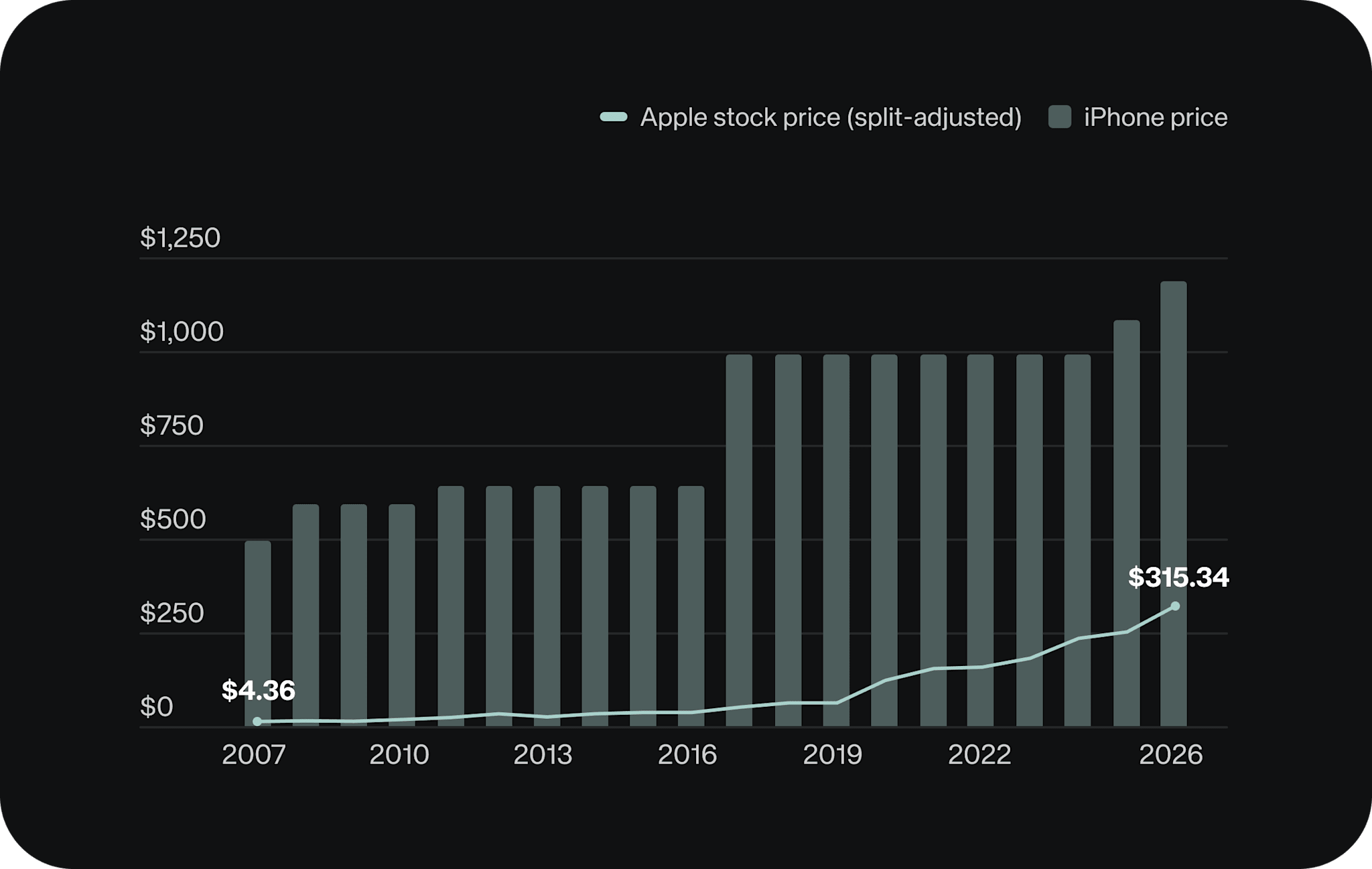
Source: Google Finance, Scalable’s Chief Economist Christian W. Röhl
When the original iPhone hit shelves in 2007, it came with a $499 price tag. Had you bought Apple equity instead, that same budget would have secured 114 shares. Fast forward to today: after several price hikes an iPhone 18 Pro now costs you $1,199 – more than double the original device price. Yet even after one of the greatest equity rallies in history, that amount still buys roughly 3.8 Apple-shares today. Owning a slice of the business remains far more affordable than buying the gadget itself – and equity actually pays you back. Blowout quarterly numbers and strong guidance heading into the festive shopping season recently sent the stock to another all-time peak.
Equal-weight ETFs
How to defuse tech concentration
For the past five years, the traditional market-cap-weighted S&P 500 left its equal-weight sibling in the dust. Over the past twelve months, however, the narrative has flipped. The tech-heavy bias that previously turbocharged the main index proved costly when the sector sold off. By contrast, the equal-weight variant held firm and climbed higher, lifted by renewed vigour across banks, industrials, and power generators.
Equal-weight ETFs give you a simple, mechanical way to tackle single-stock concentration. Instead of letting market giants dominate, each constituent company carries an identical weighting. Indices rebalance every quarter – paring back runaway winners and topping up laggards.
This naturally tilts your exposure toward economically sensitive cyclical businesses and steady, dividend-paying defensive names, which tend to hold up better when markets turn volatile.
Most Traded
Bought:
Sold:
Note: The data refers to the ratio of purchases and sales of the 100 most traded stocks on Scalable Broker between 30/10/2026 and 05/11/2026.
In the spotlight: Bayer
A forecast-beating third quarter in pharmaceuticals alongside upgraded full-year guidance catapulted Bayer’s stock to a three-year peak. Analysts hurried to lift their price targets, despite the ongoing cloud of Monsanto-related litigation continuing to hang over Leverkusen.
Good to know
What’s taking the wind out of crypto’s sails?
Crypto tokens and -ETFs have had a tough run of late. With interest rates hovering higher for longer and growing doubts around the commercial payoff of AI, investors have rotated into safer havens. Sentiment took another heavy blow following the biggest exchange hack to date, which saw roughly $6bn illicitly drained from market leader Binance. The US midterms have only added to the swings: with the digital asset sector facing the threat of stricter congressional oversight, prices remain acutely sensitive to any policy whisper out of Washington.
Scalable News
Easy credit
We’re introducing greater flexibility to your investment strategy: you can now borrow your first €1,000 via Scalable Credit entirely interest-free (0% interest)*. Our standard rate applies to anything above that threshold. Best of all, how you use the capital is entirely up to you – reinvest it in the markets or withdraw it straight to your current account.
*Credit facility up to €250,000. Variable borrowing rate, charged quarterly. Offered by Scalable Capital Bank GmbH, Munich. Leveraged investing involves risk of capital loss; eligibility criteria apply.
Adding crypto to the World Portfolio
Scalable Wealth, our managed portfolio service, is rolling out a new allocation: you can now opt to add a crypto sleeve to our flagship World Portfolio + Gold strategy. Leave the tactical asset allocation and regular rebalancing to our automated engine, giving you a truly passive hands-off experience. Enjoy the broad foundation of global equities, bonds, and commodities, the proven safe-haven qualities of gold, and targeted growth exposure to digital assets.
Discover our wealth management strategies.Retirement in Focus
Here is what English-speaking residents in Germany need to know about the upcoming reform to private pension provision.
How does the tax treatment of the new AVD compare to a Riester pension?
Both schemes follow an identical tax-sheltered logic during your working life: capital gains, interest, and dividends compound entirely free from standard German withholding tax (Abgeltungsteuer). In addition, your contributions and government subsidies qualify as tax-deductible special expenses (Sonderausgaben) on your annual tax return.
The crucial difference lies in how much you can write off: Under the traditional Riester, tax relief is strictly capped at €2,100 per year (which includes both your contributions and state subsidies). Under the new AVD, you can contribute up to €1,800, with state subsidies added on top. With a standard annual bonus of up to €540 plus €300 per child, many expats and local savers will be able to claim a significantly higher deduction under the AVD than under Riester.
Why does this matter? When you file your return, the German tax authority automatically performs a comparative assessment to ensure you receive whichever delivers the larger financial benefit: direct state subsidies or income tax deductions.
Tax is only levied once you retire and start drawing down your pot, taxed as ordinary income at your individual tax rate at that time.
Editorial deadline: Friday, 7 am
Sources: Scalable and dpa-AFX

Bits & Pieces is the heart of our editorial team, and the versatility of our writers shapes every single issue of the newsletter.
Team Lead Sophie is an economist and trained journalist who spent several years analyzing market developments live from New York as a Wall Street correspondent for outlets including ntv and Media Pioneer. As a trained business journalist and architect, Verena pursues her passion for macroeconomics and has previously reported for Focus Money and Bloomberg. Drawing on his experience as an advertising online editor and former daily newspaper reporter, Manfred uses his writing skills at Scalable to break down financial topics into a crisp, punchy format.
Above all, they all live and breathe their own passion for stocks, ETFs, and investing.
Mehr lesen?
Jetzt unseren Newsletter abonnieren und Börsen-News jeden Freitag direkt ins Postfach erhalten.
Es gelten unsere Datenschutzbestimmungen. Die Zustimmung kann jederzeit widerrufen werden.