
Plenty of growth, yet little applause. The AI race remains tense, and Big Tech has to overdeliver just to avoid a beating. We also look at how France’s mounting national debt could serve as leverage for your portfolio. Elsewhere, a major US fast-food chain is swapping Pepsi for Coca-Cola after 40 years. And with World Savings Day upon us: are you still just saving – or are you already investing?
This newsletter contains ads.
What’s on our mind
Full steam ahead or slamming the brakes
All eyes were on the tech heavyweights this week. Microsoft delivered a stellar quarter, posting a $36.6bn profit and 30% cloud growth. While Amazon notched a record operating margin of 13.9%, it missed expectations on several other fronts. Alphabet proved a let-down, bringing in $128bn in revenue after its core search business fell $2bn short of estimates – and investors wasted no time punishing the stock. Meanwhile, memory chip makers like Samsung, SK Hynix and SanDisk are thriving; their order books make clear that Big Tech has no intention of dialling back its multi-billion-dollar spending spree.
Alphabet serves as a cautionary tale of what happens when the AI narrative wobbles: miss elevated expectations while capex continues to balloon, and the market shows no mercy. To make matters worse, Apollo’s chief economist Torsten Slok noted that AI has yielded "zero return" outside the tech sector so far. For most businesses, these tools remain little more than a cost centre squeezing margins.
On the bright side, central banks aren't standing in the market's way for now: both the Fed and the ECB held interest rates steady, right in line with expectations.
VIP Watch
Au revoir, Christine
Christine Lagarde is stepping down from the ECB. Whispers had been circulating since February, in September Lagarde herself confirmed she was considering stepping aside "a few months" early. The likely political calculus? Her early exit allows outgoing French President Macron and German Chancellor Merz to lock in her successor before the French elections – avoiding a scenario where Marine Le Pen might get a say at the table.
Throwback
Goodbye PepsiCo, cheers Coca-Cola
After more than 40 years, KFC is dropping PepsiCo from its fountain lineup. From 2027, arch-rival Coca-Cola will be filling the cups instead. For PepsiCo – once KFC’s parent company – it marks a stinging defeat in the ongoing cola wars.
While both beverage giants grapple with inflation and increasingly health-conscious consumers in their US home market, their fortunes have diverged sharply. Over the past five years, PepsiCo shares have shed around 18%, whereas Coca-Cola has surged more than 60% and recently lifted its full-year guidance.
The divergence comes down to two contrasting playbooks. Coca-Cola is a pure-play drinks maker running an asset-light model via independent bottlers. PepsiCo, on the other hand, controls its entire beverage supply chain while running an even larger snack business under the same roof – yielding more brands and revenue, but also far higher operating overheads. Through cost cuts and a streamlined product lineup, PepsiCo is now scrambling to get back on track.Chart of the Week
Invest instead of losing out
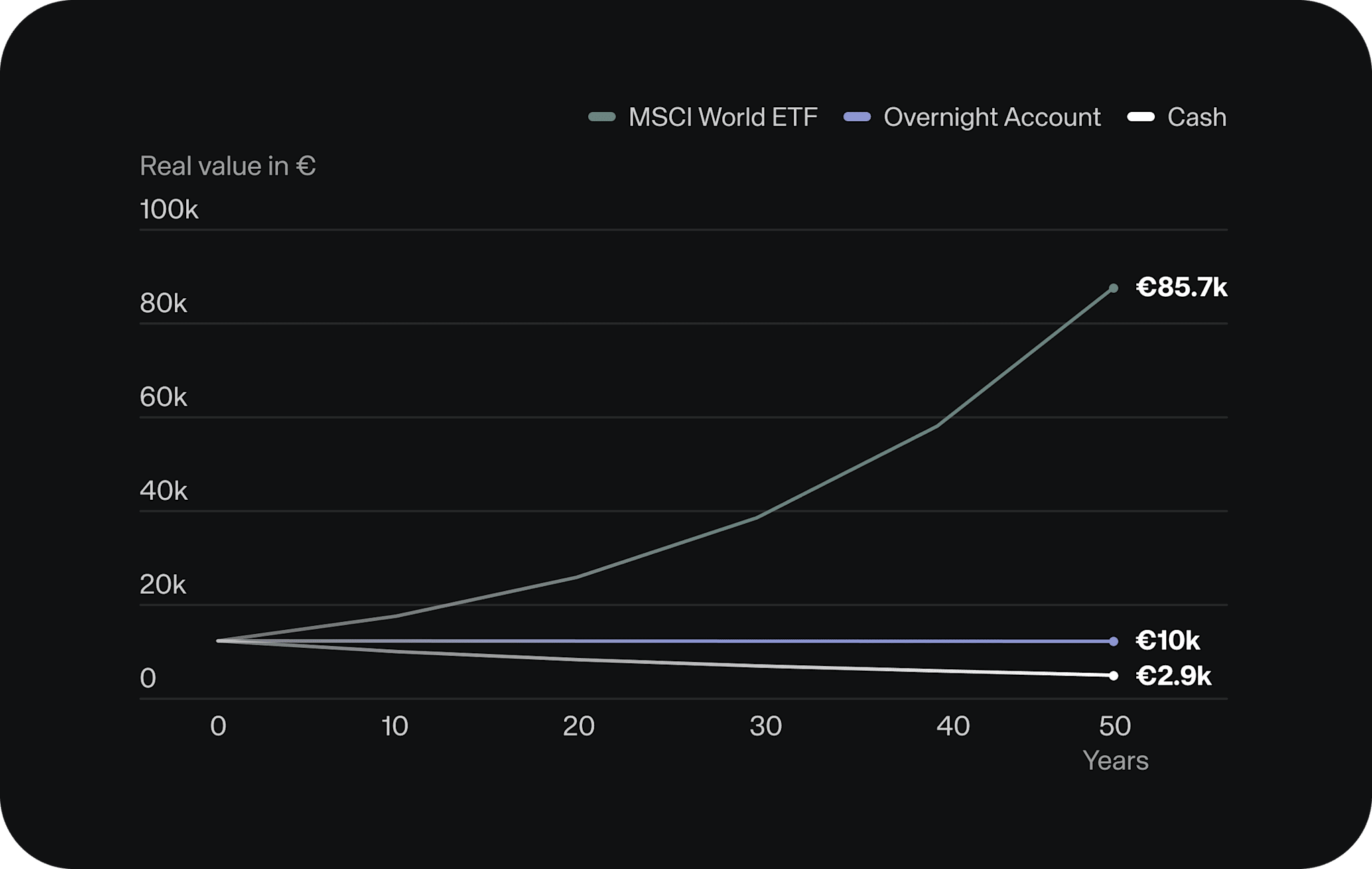
What you might get out of €10,000 over 50 years
Source: Scalable calculations
Today marks World Savings Day. But simply setting money aside won't cut it. To fend off inflation, you have to put your money to work. Tucking €10,000 under the mattress today would leave you down roughly €7,000 in real terms over 50 years, assuming 2.5% inflation. In an overnight account earning 2.5% interest, the nominal balance climbs to around €34,400 – yet in real terms, purchasing power barely holds flat at €10,000.
The real bright spot? The stock market. Historically, global equities have delivered average annual returns of over 7% over long horizons. Adjusted for inflation, that €10,000 would grow to a real purchasing power of around €86,000 after 50 years.
Bond ETFs
Leverage on Paris
France's debt woes could rattle your portfolio – but they might also open up a compelling entry point.
Yields on 10-year French government bonds have hit 5%, levels not seen since the global financial crisis. While US Treasuries offer comparable yields, the critical metric is the gap between economic growth and debt servicing costs. On that front, the outlook for France looks grim: economic momentum is sluggish, and a deeply fractured political landscape shows little appetite for fiscal discipline.
If you believe bond yields have peaked or that the ECB will step in with targeted bond purchases to compress spreads, euro bond ETFs with an 8-to-10-year maturity profile offer substantial upside leverage. Should that scenario play out, investors stand to capture great capital gains. If yields hold flat, you still collect the coupon payments.
But take note: should yields climb even higher, duration works against you, leading to sharp price drops – a dynamic that equally applies to sovereign debt from neighbouring European nations.
Most Traded
Bought:
Sold:
Note: The data refers to the ratio of purchases and sales of the 100 most traded stocks on Scalable Broker between 23/10/2026 and 29/10/2026.
In the spotlight: Boeing
Boeing posted a 4% increase in third-quarter revenue to $24.2bn, but fell short of earnings estimates. The real blow for investors, however, was a delay to its production targets: the goal of churning out 52 of its 737 Max jets a month has been pushed back to late 2027. Shares slumped in response.
Scalable News
One world – one ETF
The Scalable MSCI AC World Xtrackers ETF is now available as a distributing share class – ideal for anyone looking to generate regular income. Covering nearly 90% of the investable global equity universe and employing a hybrid replication approach, the ETF has delivered notable outperformance to date. Payouts are credited directly to your cash account on a quarterly basis.
What’s more, through to the end of 2027, you benefit from a 0.00% p.a. TER (down from the standard 0.15% per year). Learn more about our ETF.
Even more agentic power
The Scalable Model Context Protocol (MCP) now supports an expanded suite of AI assistants. You can now connect your Scalable account with Cursor, Google Antigravity, and Grok Bot. Use your preferred assistant to analyse markets, monitor your portfolio, and stage trades for your approval.
Pension boost with Scalable bonus
We’re giving away an annual bonus of €540, paid right up until your statutory retirement age. To enter, simply add the upcoming pension depot (Altersvorsorgedepot) to your Scalable Broker account – and your name goes straight into the draw. A new raffle opens every month from August to December.
Once registered, you remain entered for all remaining draws, so the sooner you sign up, the higher your odds of winning. Winners will be drawn together in early 2027. Terms and conditions apply.
Retirement in Focus
In this section, we provide quick, direct answers to your key questions about the proposed retirement savings account for Germany.
How do withdrawals differ between Riester and the new AVD?
With a Riester pension, payouts can generally start at your 62nd birthday, whereas the AVD sets the payout window between your 65th and 70th birthday. Both models allow you to take up to 30% of your accumulated capital as an initial lump sum.
For the remaining balance, Riester pays out a lifelong annuity until your death. The catch: providers typically base their calculations on very conservative life expectancy assumptions, which often depresses monthly payments. Furthermore, any remaining balance usually cannot be passed down to heirs.
With the AVD, providers can offer a choice between a lifelong annuity and a flexible drawdown plan (running at least until age 85). Once the agreed drawdown schedule concludes, payments cease and the full remaining balance is paid out to you.
Should you pass away early, any remaining funds can be inherited by your beneficiaries – though this may trigger a clawback of state subsidies and tax liabilities.
Editorial deadline: Friday, 7 am
Sources: Scalable and dpa-AFX

Bits & Pieces is the heart of our editorial team, and the versatility of our writers shapes every single issue of the newsletter.
Team Lead Sophie is an economist and trained journalist who spent several years analyzing market developments live from New York as a Wall Street correspondent for outlets including ntv and Media Pioneer. As a trained business journalist and architect, Verena pursues her passion for macroeconomics and has previously reported for Focus Money and Bloomberg. Drawing on his experience as an advertising online editor and former daily newspaper reporter, Manfred uses his writing skills at Scalable to break down financial topics into a crisp, punchy format.
Above all, they all live and breathe their own passion for stocks, ETFs, and investing.
Mehr lesen?
Jetzt unseren Newsletter abonnieren und Börsen-News jeden Freitag direkt ins Postfach erhalten.
Es gelten unsere Datenschutzbestimmungen. Die Zustimmung kann jederzeit widerrufen werden.